
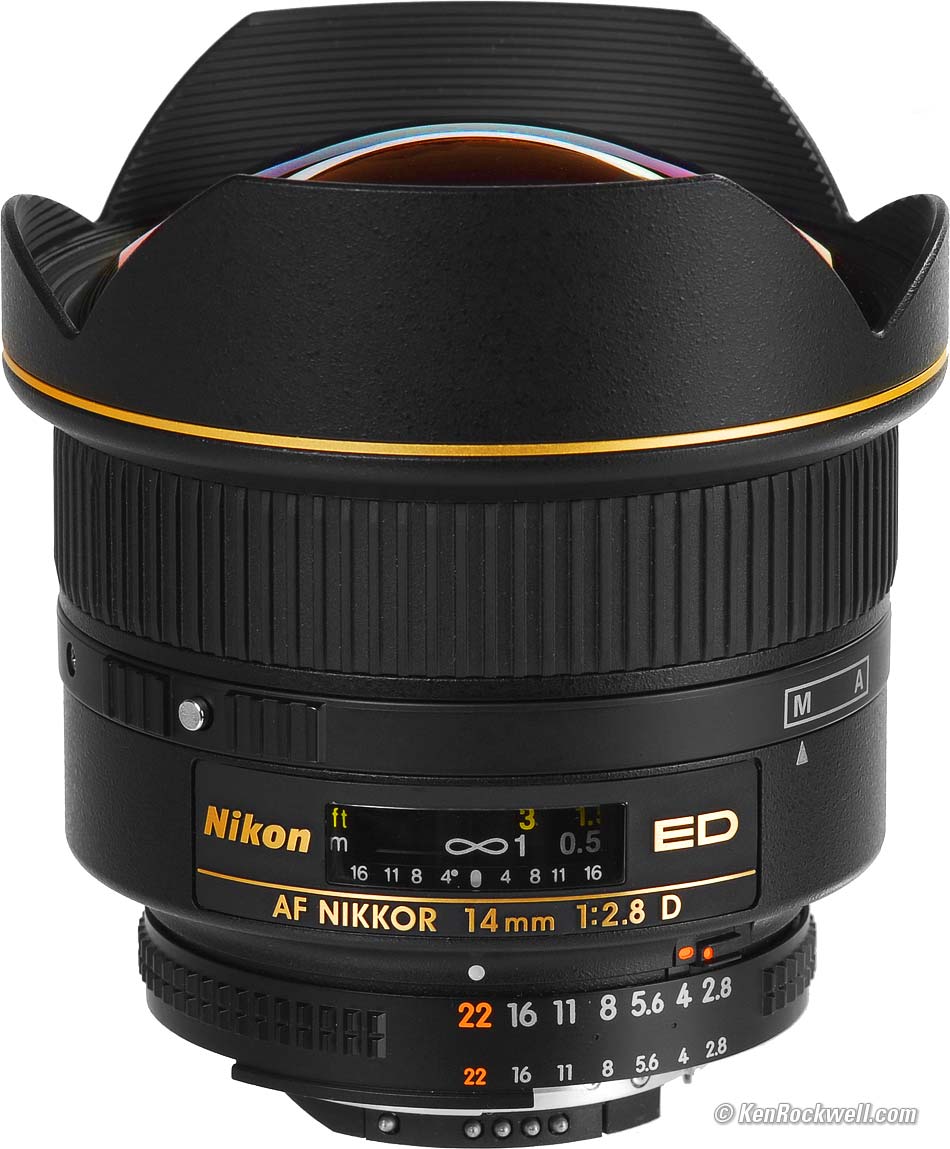
Nikon 14mm f/2.8 AF-D ED. enlarge.
I got mine from Adorama. You also can get it from Amazon or even eBay. It helps me keep adding to this site when you get yours from those links, too.
NEW: Nikon Ultra-Ultrawide Lens Comparison 23 December 2008
NEW: How to Use Ultrawide Lenses 11 August 2008
The Nikon 14mm f/2.8 AF-D is an ultra-ultrawide lens designed for film and FX digital cameras. It was introduced in 1999 at the same time as the historic D1. This fixed 14mm f/2.8 has great optics, is very solidly built and retails for about $1,450.
The Nikon 14mm f/2.8 AF-D is a huge improvement over the manual focus 15mm f/3.5 AI-s and other older ultra-ultrawide lenses.
This fixed 14mm is smaller and weighs exactly 2/3 what the huge new 14-24mm f/2.8 zoom (introduced in 2007) does. This means this fixed 14mm weighs 12 oz. (333g) less than the huge zoom!
As of 2008, I'll admit that the larger 14-24mm f/2.8 zoom is what's on my D3 80% of the time. This 14mm is unsurpassed for shooting Fuji Velvia 50, but the hulking zoom is a little sharper, has better peripheral color and is more versatile for use on FX digital.

This Nikon 14mm f/2.8 and Nikon 14-24mm f/2.8 AF-S.
For those of us who've been following Nikon's ultra-ultrawide lenses as each was introduced since the 1970s, this is Nikon's best and newest fixed ultra-ultrawide.
Unlike the old-fashioned spherical 13mm and 15mm, this much newer aspherical 14mm has none of the crippling ghosting problems of the earlier lenses, and it's much, much sharper at every aperture.
This 14mm lens covers the full FX format and 35mm film for an ultra-ultra wide view. It makes a 20mm lens seem long by comparison.
Nikon introduced this along with the first DSLR, and it was mostly popular with news photographers who had no other way to get a really wide angle on a DX digital SLR with DX' 1.5x crop factor. On a DX digital camera this is similar to a 21mm lens.
Since most of these 14mm lenses were bought to use with the Nikon D1 and D1x before the 2003 introduction of the 12-24mm, you used to be able to find them cheap on the used market since people replaced them with the far more flexible (for DX cameras) 12-24mm DX.
When the Nikon D3 was announced in August 2007, this 14mm is again very useful, and far smaller and lighter than the new 14-24mm zoom. The used bargain days are gone as these 14mm lenses are now extremely relevant to the D3. I got lucky: since the new ones were backordered, I ordered this one used from Adorama the week before the D3 was announced!
For DX digital cameras the 12-24 mm DX or Tokina 11-16mm is far better choice. These DX lenses can use front filters, and weigh and cost much less. This 14mm can't use anything except gels behind the lens. The reason today to get this 14mm is for use on film and FX cameras, not to piddle with it on DX cameras.
Compatibility
The Nikon 14mm f/2.8 lives to be used on your D3 and D700. It also feel perfect on manual focus cameras like the FA.
The Nikon 14mm f/2.8 also works perfectly on every film Nikon made since 1977. It has all the coupling lugs and AIS lens mount cutouts for matrix metering and P, S, A and M exposure modes even on the 1983 Nikon FA.
This 14mm works great on 1959-1977 cameras, but you'll have to use stop down metering, or have a meter coupling prong installed. The Nikon 14mm even has pilot dimples on its aperture ring to install this prong! Don't come complaining to me if you can't get the Nikon 14mm to work on any Nikon camera of any vintage.
As a traditional AF lens, it also works perfectly on almost every AF, digital, film and manual focus camera made since dirt. This kind of lens is the most universal Nikon lens there is. It's flawless on an F3, FA, FE, F4, F5, FG, F6, N55, D100, or whatever.
The only thing it won't do is autofocus on the D40, D40x or D60. No big deal, it won't AF on an F3 either. With the cheap digital SLRs, focus manually and look for the focus confirmation dot in their finders, which works perfectly. Ultrawide lenses have almost unlimited depth of field, so if I was silly enough to use it on my D40 I'd probably tape the focus ring at 6' (2m) so it didn't get knocked accidentally.
All the metering and exposure modes work perfectly on every digital camera, including the D40, D40x and D60. Someone with a D40 is about as likely to use this 14mm lens as someone is to use a 300mm f/2.0, a lens which had a $28,999 list price in 1985 and still sells for that much used today for motion picture use, on a Nikon N2020, which was Nikon's first and cheapest practical AF camera in 1985. Nikon actually showed this combo in the N2020's sales flyer! Likely story.
See Nikon Lens Compatibility for more details with your camera. Use the AF (screw) column.

Bottom of Nikon 14mm f/2.8 AF-D.
Name: Nikon calls this the Nikon AF Nikkor 14mm f/2.8 D ED RF Aspherical.
AF: Autofocus.
D: Sends focus distance information to the metering system.
ED: Magic glass for sharper images and less lateral secondary chromatic aberration (color fringing). See the gold metal band around the front? That how Nikon sets off their serious ED lenses, and Nikon is so serious that they really use solid gold. People argue whether it's solid 14kt or just 18 kit gold-filled, but it is gold.
RF: Rear focusing. Nothing moves except the rear internal elements.
Aspherical: Specially shaped glass elements greatly improve sharpness at large apertures and in the corners.
Optics: 14 elements in 12 groups. One of these elements is made of ED glass. Two of these are hybrid (compound) aspherical lens elements. Hybrid means gluing plastic corrective pieces to the glass elements. Rear Focusing (RF).
Diaphragm: 7 conventional blades. Stops down to f/22.
AF System: Old-style mechanical AF linkage, not AF-S. The good news is that this 14mm therefore autofocuses perfectly on every AF and digital camera except the D40 and D40x. The bad news is that you have to unlock and rotate a ring on the lens to switch between autofocus and manual focus, just like the AF 28/1.4D and AF 20-35/2.8D.
Close focus: 8" or 0.2m from the film plane, which is only inches away from the front of the lens and way too close for safety if you shoot airplane propellers.
Filters: None on front. Gelatin filter slot on rear. More at Filters.
Introduced: May 2000, right after the original D1 digital SLR.
Size: 3.427" diameter x 3.425" extension from flange (87.05 x 87.00mm), measured. 3.425 x 3.406" (87 x 86.5mm), rated.
Weight: 23.518 oz. (666.7g), measured, naked. 23.6 oz., (670g), rated.
Nikon Product Number: 1925, in catalog as of spring 2008.

Nikon 14mm f/2.8 AF-D. The bulbous front element is 3" (75mm) across.
Overall back to performance back to top
My Nikon 14mm f/2.8 AF-D works great. On film, it's uniformly sharp at all apertures and focuses instantly and exactly. It just works!
It is a huge improvement over the 15mm f/3.5 because the 15mm had horrific ghosting and flare problems.
Speed
AF is very fast, as it usually is for ultrawide lenses. One full turn of the AF screw pulls the focus from infinity down to 1.5' (0.5m).
Manual Focus
Manual focus requires pressing a button the rotating a ring. Once done, manual focus is perfect, and perfect for use on manual focus cameras, too.
There isn't really much difference between the 13mm f/5.6, 15mm f/3.5, 15mm f/5.6, 14-24mm f/2.8 and this 14mm f/2.8.
I did stick them all on a tripod to see.
The 13mm f/5.6 was easily the widest.
This 14mm f/2.8 is the next closest thing. The 14-24mm zoom at its 14mm setting doesn't really get as wide as this fixed 14mm.
The 15mm lenses are less wide.

ไม่มีความคิดเห็น:
แสดงความคิดเห็น